Goechala trek in spring at a glance
- Main attraction : Rhododendron, magnolia & orchid blooms, fresh greenery, and colorful landscapes
- Weather : Pleasant daytime temperature and cold mornings & nights
- Mountain visibility : Excellent, especially in April and May
- Flowers & flora : Best season for rhododendron and spring flowers
- Landscape : Green forests, verdant valleys, and snow patches in higher areas
- Trail conditions : Some snow patches may remain, especially in early spring
- Crowds : Moderate crowds, peaceful experience
- Photography: Best for flowers, forests, and nature photography
- Temperature : Gradually becomes warmer from March to May
- Rain chances : Low, but pre-monsoon clouds may appear in late May
Check out our Goechala trek difficulty and itinerary blog.
Spring weather conditions on the Goechala trek
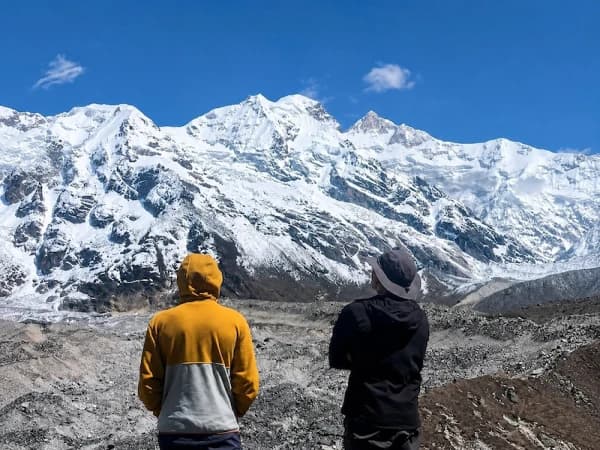
Spring is one of the most favorable seasons for the Goechala trek. It offers a perfect combination of stable weather, pleasant climate, vibrant landscapes, and breathtaking mountain vistas.
As the winter fades away with the beginning of March, the trail becomes stable and navigable. Above 4,000 meters, the weather remains unpredictable throughout the year.
However, the lower sections are safe to traverse in spring. The daytime temperature is warm, and mornings and nights are cold. The environment becomes colder the higher you ascend.
*Trekkers should pack for all types of weather and climate. Proper layering is key to a comfortable trek in the Himalayas.
Goechala trek in March:
In March, the climate, weather, and landscapes slowly begin to transition from winter to spring. The first two weeks of March carry the essence of winter, and there can be occasional snowfall.
However, the cold is not as cold as in winter. The climate slowly begins to warm up as you enter the last week of March. Snow patches begin to melt, and the scenery becomes green and colorful.
Weather conditions:
- Cold mornings and nights
- Possible snow patches around Dzongri and higher areas
- Fresh winter landscapes
- Less crowded trails
Goechala trek in April :
April is one of the perfect months for the Goechala trek in every aspect. This month offers an ideal combination of stable weather, pleasant climate, colorful landscapes, incredible visibility, and phenomenal mountain views.
The lower hills are blooming with rhododendrons, and terraces are covered with paddies. Forests are lush, and rivers and waterfalls are in their best conditions.
You will capture picture-perfect landscapes in spring. The climate remains cold at high elevation, but it is manageable. For camping, April is the most optimal month.
Weather conditions :
- Stable trekking weather
- Rhododendron blooming season
- Clear Himalayan views
- Comfortable daytime temperatures
Goechala trek in May :
As May begins, the climate gets warmer, and landscapes become greener. The daylight hours are long, and the visibility is great in the first two weeks of May.
In the last two weeks of May, there can be occasional clouds. It indicates that the season is once again transitioning into summer. The entire month of May is a favorable time for the Goechala trek.
Weather conditions:
- Warmer daytime temperatures
- Lush forests and valleys
- Longer daylight hours
- Increasing chance of afternoon clouds
Goechala trek temperature in spring
On the Goechala trek, you will pass through different altitudes, so the temperature significantly varies from lower forest areas near Yuksom to high-altitude camps like Dzongri, Thansing, and Goechala Viewpoint
| Location |
Altitude |
March |
April |
May |
| Yuksoom |
2,900–3,000 m
|
Day: 18–22°C
Night: 8–12°C
|
Day: 20–25°C
Night: 10–14°C
|
Day: 22–26°C
Night: 12–16°C
|
| Sachin/Tshoka |
2,900–3,000 m |
Day: 12–18°C
Night: 3–8°C
|
Day: 14–20°C
Night: 5–10°C
|
Day: 15–22°C
Night: 7–12°C
|
| Dzongri |
3,950 m |
Day: 12–18°C
Night: 3–8°C
|
Day: 8–15°C
Night: -3 to 3°C
|
Day: 10–18°C
Night: 0–5°C
|
| Thansing |
3,930 m |
Day: 5–12°C
Night: -5 to 0°C
|
Day: 8–15°C
Night: -3 to 2°C
|
Day: 10–16°C
Night: 0–5°C
|
| Goechala View Point |
4,700–4,900 m |
Day: -2 to 5°C
Night: -10 to -5°C
|
Day: 0–8°C
Night: -8 to -3°C
|
Day: 3–10°C
Night: -5 to 0°C
|
Khangchendzonga National Park in spring season
The Khangchendzonga National Park is a UNESCO World Heritage Site. It is home to a diverse ecosystem and a wide variety of wildlife, bird species, and vegetation. The Goechala trek route runs inside this national park.
As the trail ascends and descends through varying elevations, you will explore diverse vegetation (sub-tropical to alpine). The trail goes through verdant valleys and lush forests of rhododendron, magnolia, orchids, oak, fir, birch, maple, etc.
Likewise, the Khangchendzonga National Park is home to rare wildlife such as red panda, snow leopard, clouded leopard, golden cat, Himalaya black bear, Tibetan wolf, Himalayan tahr, musk deer, goral, etc.
Different types of birds, including Himalayan monal, blood pheasant, and Satyr Tragopan, are also found in this national park.
The wild animals mainly live deep inside the region and do not often show on human trails. Some lucky trekkers may get to see the red panda and the Himalayan monal.
Best viewpoint during the Goechala trek route
Viewpoints are usually elevated areas along the trail, from where you get to see gorgeous sunrises and jaw-dropping mountain vistas. Spring makes the scenery incredible, and the viewpoints let you witness the widespread spring scenery.
Tshoka:
Tshoka sits at 2,983 meters. It is the first viewpoint on the Goechala trek route. From here, you will see striking views of Mount Pandim, dense green forests, verdant mountain valleys, and many other snow-covered mountains.
- Mountain views you will see from Tshoka: Mt.Kanchenjunga, Mt.Pandim and Mt.Kabru
Dzongiri:
Dzongri sits at 4,200 meters. From here, you will enjoy a gorgeous sunrise, a wide panoramic view of the Himalayan range, and a vast alpine landscape below.
- Mountain views you will see from Dzongri: Kanchenjunga, Pandim, Kabru, Jhopuno, Tenchenkhang, and Koktan
Lampokhari Lake:
Lampokhari Lake is one of the oldest freshwater lakes in Sikkim. You can visit Lampokhari Lake on a 4-hour round trip from the Dzongri campsite. The trail goes through Dzongri meadows. It is a beautiful, hidden lake surrounded by rocky hills and snow-covered mountains.
Thangshing:
Thangshing is a beautiful campsite at 3,930 meters. From here, you can witness expansive views of the Himalayan peaks. The view of Mt. Pandim is especially breathtaking from here. Along with that, you will also see a mesmerizing view of Kanchenjunga.
- Mountain views you will see from Thangshing: Pandim, southern ride of Kanchenjunga, and Onglakhing glacier
Lamuney:
Lamuney is around 100 meters above Dzongri. As you are above the treeline at this point, the landscape is rocky and stark with massive peaks and dramatic alpine scenery.
- Mountain views you will see from Lamuney: Kanchenjunga, Pandim, Kokthang, Rathong, and Kabru
Samiti Lake:
Samiti Lake is situated at 4,300 meters. It is a beautiful turquoise-colored lake surrounded by snow-covered mountains and rocky terrain. The overall scenery is 100% photography worthy.
- Mountain views you will see from Samiti Lake: Pandim, Kabru, Kanchenjunga, and Tenzing Khang
Goechala viewpoint:
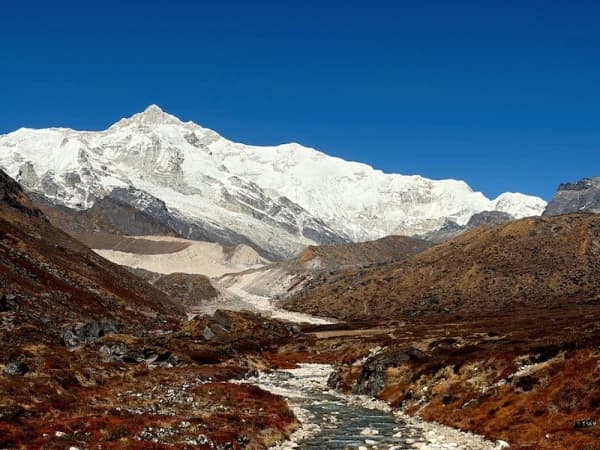
It is the ultimate viewpoint on the Goechala trek route. From here, you will enjoy a close-up view of Mt. Kanchenjunga, the 3rd tallest mountain in the world. You can see many other mountains such as Kabru, Rathong, Pandim, etc.
- Mountain views you will see from Goechala Viewpoint: 14 major peaks including Kanchenjunga, Pandim, Kabru, Jannu, Simvo, Tenchenkhang, etc
Who should consider doing the Goechala trek in spring?
Sikkim is one of the most beautiful states in India. Surrounded by mountains and a rich cultural heritage, trips here are lifetime ventures. The Goechala trek is one of Sikkim's most daring, adventure-packed, and wilderness journeys.
This trek is best suited for adventure seekers who want to enjoy high-altitude trekking, Himalayan landscapes, and unforgettable mountain vistas. The Goechala trek is perfect for:
*Note that the Goechala trek is not recommended for complete beginners without proper preparation. You have to be fit and comfortable walking 5-6 hours a day on average, and a bare minimum service.
Experienced trekkers:
The Goechala trek is not an easy hike. It includes steep ascents and descents for multiple days and demands determination and patience. Experienced trekkers will best enjoy this trek because they are well aware of challenges, limitations, weather, and aspects of high-altitude Himalayan treks.
Adventure enthusiasts:
If you are always seeking your next adventure, the Goechala trek in India could be a perfect addition to your list.
Mountain and nature lovers:
The Goechala trek is not a busy trekking route. You will enjoy a peaceful time in nature on this trek. Likewise, this trek offers the most excellent mountain vistas of Kanchenjunga, Pandim, Kabru, Rathong, Kumbhakarna, Simvo, etc.
Photography enthusiasts:
You will get to capture some of the prettiest landscapes and mountain vistas on the Goechala trek in the spring season. Imagine colorful, blue skies, lush hills, rivers, waterfalls, and dramatic Himalayan mountains as a backdrop.
Quieter Himalayan experience:
The Goechala trek requires camping, which is expensive. So, the expenses included in this trip itself keep this trek route less busy. Likewise, there are no villages on the trail. So, you will enjoy a remote, peaceful journey.
Recommended packing for the Goechala trek in spring
You have to pack according to the season for a smooth and safe trek. It is important to pack lightly while ensuring you have all the necessary items for the journey.
Below, we have shared a well-planned packing list for the Goechala trek that focuses on warmth, layering, comfort, and protection. You will not miss out on anything by following the link bellow this packing list. ( Trekking Equipments List )
Altitude awareness for the Goechala trek
The Goechala trek takes you to an elevation of 4,900 meters above sea level. It is quite a high altitude gain, especially for those who come from sea-level cities.
As you ascend from the low forests of Yuksom to higher regions like Dzongri, Thansing, and Goechala, the air becomes thin, and the oxygen level decreases. Your body needs time to adjust.
That is why we have included acclimatization days in our Goechala trek itinerary. It allows trekkers to adjust to a high-altitude environment and thin air, which ultimately leads to avoiding altitude sickness.
Altitude sickness:
Altitude sickness occurs when you quickly gain elevation without acclimatizing. Your body is not used to low oxygen levels and a high-altitude environment.
So, it can show discomfort such as headache, dizziness, vomiting, nausea, loss of appetite, shortness of breath, and difficulty sleeping. This is what we call altitude sickness.
Not every trekker suffers from altitude sickness, but unless you have previous high-altitude experience, you never know how your body is going to react to drastic altitude gain. So, we stay vigilant and follow proper preventive measures such as:
- Ascend slowly
- Maintain a steady pace
- Stay hydrated
- Avoid alcohol and smoking
- Eat adequate food and get proper sleep
- Listen to your body
Inform your guide if you feel sick or experience any discomfort
Sustainable Goechala trek
You will be traveling in a fragile ecosystem of Khangchendzonga National Park during the Goechala trek. The spring season additionally brings several delicate wild flowers, medicinal herbs, and other vegetation.
So, you have to trek mindfully and practice sustainable trekking. It helps preserve and protect the fragile ecosystem for future generations.
We, Ashmita Trek and Tours, follow the Leave No Trace principle during the Goechala trek. We make sure not to harm nature in any way and minimize our impact as much as we can.
We bring all our non-biodegradable waste back. Trekking with us means you will be traveling responsibly. We respect nature, wildlife, locals, and vegetation, and we expect the same from our dear trekkers.
Final thoughts:
Spring offers the most beautiful scenery and optimal trekking conditions, which makes it the best time for the Goechala trek.
- One of the biggest reasons to choose spring for the Goechala trek is the astonishing rhododendron blooms. The forest trail around Yuksom, Tshoka, and Dzongri becomes extremely beautiful with rhododendrons.
- If you want to see the close views of Mt. Kanchenjunga, the Goechala trek in spring is perfect. In addition, you will see jaw-dropping views of many other mountains.
- Comfortable trekking and camping conditions. The trails are sturdy and dry. The temperature is moderate (neither too hot nor too cold).
- The magical winter-to-spring landscape transition. If you do the Goechala trek in March, you may witness mesmerizing winter/spring scenery. It will include snow with greenery sprouting and blooming flowers in the lower valleys.
- If you want to capture a picture-book-like scenery, do the Goechala trek in spring.
Spring is the best time to do the Goechala trek. We, Ashmita Trek and Tours, make the Goechala trek in spring or any other season seamless with our professional service and incredible support.
Whether you choose to trek in spring or autumn, we are your perfect camping partner. We provide all necessary camping essentials, including tents, so you do not have to worry about purchasing gear.
Our local team will help you plan a safe, well-paced itinerary, arrange experienced guides, secure permits, and ensure you are fully prepared for the trail conditions. Whether you are a photographer, culture enthusiast, or a traveler seeking a peaceful Himalayan journey, we are dedicated to making your Sikkim Goechala trek smooth, safe, and memorable.
Book your Goechala trek package with us today to start planning. If you have any questions about trekking during the spring season, please feel free to CONTACT US anytime.