Sikkim Goechala Trek - 11 Days

Sikkim Goechala Trek - 14 Days

675 reviews
442 reviews
Recommended by 99% of travelers
Watch Video
Photos
Customize Trip

The Sikkim Goechala trek is undoubtedly one of the most popular trekking routes in India. It is renowned for offering the best views of the Kanchenjunga range, the third-highest mountain in the world.  If you are in search of an adventurous high-altitude camping trek in India, the Goechala trek is the perfect choice. It is a remote, wilderness trek that traverses through varying elevations. 

Along with Mt. Kanchenjunga, you will also see many other Himalayan mountains such as Pandim (6,691 m), Kabru (7,412 m), Kumbhakarna (7,710 m), Rathong (6,678 m), Simvo (6,812 m), etc. Not only that, but the Sikkim Goechala trek is also culturally enriching because you get to explore the historically rich villages such as Yuksom and Pelling. 

The trail to Goechala Viewpoint passes through beautiful mountain villages,landscapes,river,lake and where you see the traditional mountain lifestyle and the unique culture of the villagers. 

Trip Facts
Duration
14 Days
Trip Grade
Moderate to Difficult
Country
India
Maximum Altitude
4,940 m - 16,207 ft
Group Size
2 - 12
Starts
Bagdogra Airport (IXB)
Ends
Bagdogra Airport (IXB)
Activities
Trekking and Hiking
Best Time
March - May, Sep - Nov
Overview

The Sikkim Goechala trek takes you to the northeastern state of Sikkim. The trail travels deep into the heart of Khangchendzonga National Park, where you will discover rich biodiversity and untouched natural beauty.

The Goechala trek is especially famous among trekkers who wish to see close-up views of Mt. Kanchenjunga (8,586 m), the 3rd tallest mountain on Earth.

Unlike the commercial trekking routes in India, the Sikkim Goechala trek offers a peaceful journey and an authentic Himalayan experience. You do this trek in camping style.

So, imagine sleeping under skies full of stars and a bonfire every night. Our kitchen crew and porters will take care of setting up tents and cooking meals. Therefore, the journey will be hassle-free for you. Along the trail, you will explore beautiful mountain villages, Buddhist monasteries, dense forests of rhododendron and magnolia, and high alpine meadows.

The trail includes hanging suspension bridges, streams, and waterfalls. Likewise, there will be steep, narrow tracks, too. With adventure, the journey will be culturally rich, too. Meet with the locals and get to know them and their culture closely.

When thinking about the Goechala trek best time to visit, it is indeed during the month of October. As a matter of fact, the Goechala trek in October offers pleasant weather and clear skies, providing optimal visibility. You can also enjoy this trek in March, April, May, mid-September, and November. Make sure to pack according to the climate. 

Highlights

  • Embark on one of the most adventurous camping treks in India

  • Trek through varying elevations in the Khangchendzonga National Park and explore its rich biodiversity

  • Witness close-up views of Mt. Kanchenjunga, the third-highest mountain in the world

  • Enjoy a peaceful trek and an authentic Himalayan experience

  • The trail goes through dense forests of rhododendron, magnolia, oak, and bamboo

  • Pass by small villages on the way, where you will see the unique mountain lifestyle and culture

  • Cross alpine meadows and walk through glacial moraines at upper elevation

  • Witness diverse landscapes and stunning mountain views of Pandim, Kabru, Rathong, Kumbhakarna, Simvo, etc

  • Explore the gorgeous alpine ice lake, Samiti Lake, on the way

  • Discover Buddhist stupas, mani walls, chortens, prayer wheels, and prayer flags throughout the trail

  • Stand on the top of Goechala Viewpoint, from where you will see a gorgeous sunrise and an unparalleled mountain panorama

  • Explore ancient monasteries and Sikkimese culture in Yuksom and Pelling

Sikkim Goechala trek itinerary

The Sikkim Goechala trek is a 14-day journey. It starts with your arrival at the Bagdogra Airport (IXB). Our team will pick you up from the airport and escort you to Yuksom.

Yuksom is the first historical capital of Sikkim. Here, you will spend an acclimatization day and gear up for the trek. You can buy trekking gear in this village.

In Yuksom, you will visit the Norbugang Coronation Throne (where Sikkim's first Chogyal was crowned in 1641), Dubdi Monastery (the oldest monastery in Sikkim), and the beautiful Kathok Lake.

To reach the Dubdi Monastery, you have to hike for 30 minutes above Yuksom village. The monastery sits at 2,100 meters above sea level. It will be an acclimatization hike.

The Goechala trek starting point is Yuksom. From here, you will slowly ascend to Sachen (1,880 m) through dense rhododendron and oak forest. The trail goes along the Rathong Chu River Valley and passes by the Bakhim forest checkpoint.

After a night's stay in Sachen, you will ascend to Tshoka (3,050 m) via Bakhim (2,740 m). The next day, the trail sharply climbs via rhododendron and magnolia forests to Phedang meadows (3,650 m).

Slowly, Mt. Kanchenjunga's views begin to open up. Upon reaching Dzongri (4,030 m), you will witness an excellent view of Kanchenjunga, Narsing, and Pandim.

You will spend an acclimatization day in Dzongri and continue to Thangshing (3,930 m) the following day. The travel traverses across open high-altitude meadows and crosses the Prek Chu stream.

From Thangshing, you will climb past the ruins of Deuta Ghar (4,100 m) and follow the Onglathang Valley to reach Lamuney (4,200 m) for a night's stay. Finally, you ascend to Goechala Viewpoint (4,940 m) from here.

On the way to Goechala Viewpoint, you will pass by the gorgeous Samiti Lake and walk through rocky moraines. Enjoy an unparalleled sunrise and mountain panorama from the viewpoint and descend to Kokchurang (3,700 m) to spend the night.

Following the same route back, descend to Tshoka. Spend a night in Tshoka and descend to Yuksom, where the Sikkim Goechala trek 14 days ends.

For the final adventure, we will take you to Pelling (2,150 m). On the way, visit the holy Khecheopalri Lake. Pelling is one of Sikkim's most popular hilltop towns. Here you will explore the 17th-century Pemayangtse Monastery. It is one of the oldest and most important monasteries in Sikkim.

Similarly, visit the Rabdentse Ruins (known as the second capital of Sikkim) and Sangachoeling Monastery. The next day, you will drive to Siliguri. Spend a night in Siliguri and fly out via Bagdogra Airport (IXB) on the 14th day of the trip.

What to expect during the Sikkim Goechala trek 14 days?

  • The Sikkim Goechala trek 14 days is an incredible Himalayan journey packed with adventure, scenic views, wilderness, and mountain culture.

  • Trekkers can expect a spectacular view of Mt. Kanchemjunga and other stunning mountain vistas.

  • The trail winds through different elevations, offering diverse landscapes that go from dense forests of rhododendron, magnolia, oak, pine, and bamboo to alpine meadows and glacier moraines.

  • Explore the rich biodiversity of the famous Khangchendzonga National Park.

  • Unlike other trekking routes in India, the Goechala trek offers a peaceful journey and an overnight stay at quiet campsites.

  • The Sikkim Goechala trek is challenging but also very rewarding. From mountain vistas to cultural encounters and the remoteness of the region, you will enjoy every bit of the trek.

  • Push yourself through tough, steep climbs and high altitudes. Constantly adjust to a changing environment. Completing the Sikkim Goechala trek will be a huge achievement.

  • Enjoy a perfect remote camping trek deep into the Himalayas. Alpine tents, friendly crew, hot meals, and serene moments high in the Himalayan valleys will wrap your heart with warmth.

Cultural experiences during the Sikkim Goechala trek

On the Sikkim Goechala trek, you will explore Buddhist culture, mountain lifestyle, ancient traditions, and the spiritual connection of locals with mountains and nature. Meet with the Lepcha, Nepali, and Bhutia communities of Sikkim and get to know their culture and customs closely.

In Yuksom and Pelling, you will explore the history of Sikkim, ancient monasteries, traditional homes, local markets, and Buddhist monuments. As you ascend high in the mountain, you will see colorful prayer flags, mani walls, chortens, prayer wheels, and stone carvings throughout the trail.

The deep connection of locals with nature and mountains, the Himalayan lifestyle, and the warm hospitality of the locals will amaze you. Observe the yak herding culture and the simple, fulfilling lives of the locals.

Scenery and mountain views during the Goechala trek

The Goechala trek is one of the most impressive treks in India to witness diverse scenery and outstanding mountain vistas. As the trail ascends through varying altitudes, you will witness different landscapes.

  • Yuksom to Tshoka : While trekking from Yuksom to Tshoka, you will see dense oak, magnolia, and bamboo forests that ascend into rhododendron forests. There are rivers, suspension bridges, and waterfalls on the way.

  • Tshoka to Dzongri : While trekking from Tshoka to Dzongri, you will see the first views of the big mountains. The trail climbs above the treeline to Phedang meadows. From Dzongri, you will see excellent views of Mt. Kanchenjunga, Mt. Pandim, and Mt. Kabru.

  • Dzongri to Lamuney : Between Dzongri and Lamuney, you will explore high alpine meadows. Towering mountains surround the valleys. The sweeping views of the mountains, with their stark, glacial landscapes, are humbling.

  • Samiti Lake : Samiti Lake is famous for its beautiful turquoise waters and surrounding snow-covered peaks. On a bright, clear day, the reflection of Mt. Pandim and the surrounding hills creates a magical scene.

  • Goechala Viewpoint : As you get close to Goechala Viewpoint, you will see unparalleled views of the Kanchenjunga range in each step. Not only that, the Talung Glacier, Samiti Lake, and over 14 Himalayan summits fill the sky.

Sikkim Goechala trek difficulty :

The Sikkim Goechala trek difficulty is rated as moderate/challenging. It is one of India's most physically demanding treks. On this trek, the travelers travel through remote mountain landscapes and ascend up to 4,940 meters above sea level.

Fortunately, there is no technical climbing on the Goechala trek route. However, you need to be physically fit and mountain smart to do this trek and enjoy it to the fullest.

If you are trekking for the first time and picked the Sikkim Goechala trek as your first adventure, it could be a lot to handle. Realistically, you should start with easier treks such as the Singalila trek, Dzongri trek, Poon Hill Trek or Sandakphu trek and then do the Goechala trek.

The Goechala trail challenges :

There are steep ascents and consistent uphill walking on the Goechala trail. Thin air, changing weather, and remote mountain conditions will exhaust you sooner than you may imagine. At the start of the trek, you will trek through dense forested hills inside the Khangchendzonga National Park. Then come stone staircases (especially between Tshoka and Dzongri). The trail soon changes to rocky paths, alpine meadows, loose stones, narrow mountain tracks, and glacial moraines.

Deily Trek duration :

You will hike 5 to 6 hours on average during the Sikkim Goechala trek. On the Goechala Viewpoint push day, you will walk for around 8 to 10 hours. It includes ascending from Lamuney to the viewpoint and descending back to Kokchurang.

High altitude challenges :

You will start the Sikkim Goechala trek from Yuksom at 1,780 meters and ascend to Goechala Viewpoint at 4,940 meters in eight days. The altitude jump from Sachen to Tshoka and Tshoka to Dzongri is almost 1,000 meters each day. And this makes a huge difference. Exposure to thin air, cold climate, and low oxygen levels is quick. Therefore, you have to ascend slowly and maintain your pace.

Weather and cold climate :

The weather in the mountains changes rapidly, even during the peak trekking seasons. The higher you ascend, the colder the climate gets, especially at night and in the mornings. Cold winds, frosty mornings, freezing nights, and occasional snowfall can happen in spring and autumn, too. So, you have to be prepared for all weather and climate.

Mental challenges :

Constant change in weather, cold climate, long walking hours, and limited facilities not only push you physically but also challenge you mentally. You have to accept the remoteness of the Goechala trek and limited facilities and have a positive mindset. You need patience, resilience, and determination.

Age factor :

There is no age limit for the Goechala trek. However, trekkers in their 60s and 70s should consider their health, heart, lungs, and overall fitness before doing this challenging trek.

Is the Sikkim Goechala trek suitable for you? How to prepare for the trek?

The Sikkim Goechala trek is more challenging than you may have imagined. Do not take this trek lightly. Although previous trekking experience is not mandatory (but highly recommended), you need good fitness, and that is non-negotiable. If you cannot walk 6 hours a day on rugged terrain or if your knees cannot handle steep uphill and downhill walking, you are not eligible for the Goechala trek.

There will be rapid altitude gain on this trek. If you have heart or lung issues, you should consider meeting with your doctor before doing the Sikkim Goechala trek. The fitness benchmark for this trek is good fitness and health, with the ability to handle a remote camping trek and 5 to 6 hours of walking each day on rugged terrain.

Sikkim Goechala trek training plan :

You can train for 2 to 3 months before starting the trek. Include regular long walks, strength training, and cardio exercises in your training routine. Improve your stamina, strength, and endurance in this period. Check out our physical fitness training guide blog for more information : Click the link 

Sikkim Goechala trek cost and booking 2026

You will get the best Sikkim Goechala trek cost with Ashmita Trek and Tours. We provide full camping service at our Sikkim Goechala trek price. There will be no hidden charges. You can check out our Sikkim Goechala trek cost in the top right corner of this page. Likewise, check what is included in our Sikkim Goechala trek package in our "Cost Includes and Excludes" section on this page and budget personal expenses accordingly.

Bookings are open for the Sikkim Goechala trek 2026 departures. As the best trekking season, autumn, is right around the corner, it is the perfect time to book the trek and start preparing. Feel free to Contact Us anytime, if you have any questions about the Goechala trek.

Sikkim Goechala Trek - 14 Days Itinerary Outline

  • Day 01: Arrive at Bagdogra Airport (IXB) and drive to Yuksom[1,780 m/5,840 ft]
  • Day 02: Acclimatization day in Yuksom[1,780 m/5,840 ft]
  • Day 03: Trek from Yuksom to Sachen[1,880 m/6,168 ft]
  • Day 04: Trek from Sachen to Tshoka via Bakhim[2,983 m/9,786 ft]
  • Day 05: Trek from Tshoka to Dzongri via Phedang[4,020 m/13,189 ft]
  • Day 06: Acclimatisation day at Dzongri[4,200 m/13,779 ft]
  • Day 07: Trek from Dzongri to Thangshing[3,930 m/12,894 ft]
  • Day 08: Trek from Thangshing to Lamuney via Deuta Ghar[4,200 m/13,779 ft]
  • Day 09: Trek from Lamuney to Goechala Viewpoint 1 via Samiti Lake, and back to Kokchurang (3,700 m)[4,940 m/16,207 ft]
  • Day 10: Trek from Kokchurang to Tshoka via Phedang (3,650 m)[2,983 m/9,786 ft]
  • Day 11: Trek from Tshoka to Yuksom[1,780 m/5,840 ft]
  • Day 12: Drive from Yuksom to Pelling (cultural tour later in the day)[2,150 m/7,054 ft]
  • Day 13: Drive from Pelling to Siliguri[120 m/393 ft]
  • Day 14: International flight out of Bagdogra Airport (IXB)
Sikkim Goechala Trek - 9 Days
Trip Plan

Sikkim Goechala Trek - 14 Days Itinerary

Note: If you are interested in trek-to-trek 9 days itinerary, we can also do that. It will not include your arrival and departure from Yuksom.  

the-old-ridge-on-the-way-to-oechala-303

Upon landing at Bagdogra Airport (IXB), you can meet our driver, who will be there to pick you up. You will enjoy a scenic drive northeast into Sikkim. The highway climbs slowly through tea gardens, the Teesta river valley, and dense subtropical forests. On the way, you will pass through Jorethang and Legship. Legship is a great place for a lunch break. Yuksom is the historical first capital of Sikkim.

-shoka-on-the-way-to-goechala-45

Today, you will spend one more day in Yuksom. It is great for acclimatizing, and you get to explore this historically rich village. After breakfast, you can visit the Norbugang Coronation Throne (where Sikkim's first Chogyal was crowned in 1641), Dubdi Monastery (the oldest monastery in Sikkim), and the beautiful Kathok Lake. To reach the Dubdi Monastery, you have to hike for 30 minutes above Yuksom village. The monastery sits at 2,100 meters above sea level.

pic-from-dzongri-view-point-34

On the first day of the trek, you will slowly ascend from Yuksom to Sachen. The trail goes through dense forests of rhododendron and oak. You will be trekking along the Rathong Chu River Valley. Along the way, it crosses a few wooden bridges and passes through the Bakhim forest checkpoint. The trail is well-defined and lush, so the hike will be pleasant. Wear sturdy trekking boots for better grip while hiking.

pic-at-ikkim-zongri-top06

Leaving Sachen, you will ascend to Tshoka. It is going to be a significant elevation gain, but you will be fine because we ascend slowly. The trail comes out of the river valley.

You will trek through Bakhim (2,740 m), which is a forest camp surrounded by rhododendron and dense conifers. From here, follow the Uphill Trail to Tshoka. Tshoka is a beautiful village camp. Here, you will explore stone huts and enjoy stunning mountain vistas.

*If you feel any discomfort or feel sick, inform your guide. As the elevation gain is over 1,000 meters on this day, you may experience high-altitude effects. It is normal.

The trek from Tshoka to Dzongri is going to be very rewarding. It will be another long ascent of almost 1,000 meters. The trail sharply climbs through rhododendron and magnolia forests. Soon you will arrive at Phedang Meadows (3,650 m). The view of Mt. Kanchenjunga begins to open up from here. The final ascent will take you to Dzongri. It will be a steep climb from Phedang to Dzongri, but you will witness excellent views of Kanchenjunga, Narsing, and Pandim.

*Again, a big altitude jump from Tshoka to Dzongri can bring headaches or other high-altitude effects. Drink 2-3 liters of water, soups, and ginger-honey tea. Also, hike slowly, especially above Phedang.

Today, you will take a second rest day in Dzongri. Early in the morning, you will hike to Dzongri Top (4,200 m). It will be around a 30-45 minute hike above the campsite. On a clear morning, you will see a gorgeous sunrise from Dzongri Top along with breathtaking mountain vistas of Kanchenjunga, Pandim, Narsing, Tharpu Chuli, and Kabru massif.
After the hike, return to the campsite at Dzongri to spend the night.

Leaving Dzongri, you will descend a few meters and traverse across open high-altitude meadows. On the way, witness beautiful mountain views. The trail crosses the Prek Chu stream and gradually ascends from here to Thangshing. It is located in a gorgeous valley directly below Pandi's south face. The Thangshing camp is remote and wild. It is fully exposed, so the wind can be fierce. You need a -10°C sleeping bag.

The ascent from Thangshing to Lamuney is short, but the elevation gain is high. Leaving Thangshing, you will slowly climb past the ruins of Deuta Ghar (4,100 m). It is an old stone shelter used by herders. The trail further follows the Onglathang Valley and ascends to Lamuney. Lamuney is a stark glacial moraine camp. The view of Kanchenjunga South Face is incredible from here.

*We have kept this day short intentionally so that you can rest and recover before the final push to Goechala Viewpoint.

Today is the main climax of this trek. You will begin ascending to Goechala Viewpoint at 3-4 AM to see the sunrise and a heavenly mountain panorama. On the way, cross the frozen Samiti Lake (4,200 m). It looks ethereal in the morning darkness. From here, the trail ascends steeply up the moraine and crosses a boulder field. From the top of the Goechala Viewpoint, you will witness a jaw-dropping panorama of Mt. Kanchenjunga, including Kanchenjunga Main, Central, South, Koktang, and Rathong. After enjoying the view, descend all the way to Kokchurang to spend the night.

*While walking on loose rock and moraines, trekking poles are a must. In addition, we may use micro camprons if there is snow.

The day begins early with a big breakfast. Then get ready for a long descent from Kokchurang to Tshoka. You will be retracing the trail as you descend to Phedang and then to Tshoka. The downhill walk is not that challenging, but your knees may feel a little strain on the steep sections. So, trekking poles are a must. The trail goes through familiar rhododendron forests.

Today is the last day of the trek. From Tshoka, you will descend to Yuksom. The trail goes through Bakhim and Sachen. You will trek through lush forests. Upon arriving at Yuksom, have hot showers and enjoy fresh food. In the evening, you can enjoy a farewell dinner with your guide.

You will drive out of Yuksom today. Following the west highway, drive to Pelling. It is one of Sikkim's most popular hilltop towns. On the way to Pelling, you will come across the holy Khecheopalri Lake. This lake is known as a wish-fulfilling lake and is sacred for both Buddhists and Hindus. 

Later in the day, you will explore Pelling. Visit the 17th-century Pemayangtse Monastery. It is one of the oldest and most important monasteries in Sikkim. Likewise, explore the Rabdentse Ruins, known as the second capital of Sikkim. We will also explore the Sangachoeling Monastery. If the sky is clear, we can visit the Pelling Sky Walk to see the Kanchenjunga range.

Aftre your healthy breakfast at hotel You will leave Pelling drive down the hills of Sikkim to Siliguri in the plains. It will be a scenic ride through the lower Rangit Valley. You have a free evening in Siliguri. Explore its bustling market, shop, and enjoy Frewell dinner on the last night in Sikkim Trek. 

*A night stay in Siliguri allows travelers to catch their international flight from the Bagdogra Airport on time. Previously, we have seen travelers miss their flight after driving directly from Pelling to the Bagdogra Airport because of the long ride (6-7 hours). So, we have included a night stay in Siliguri. You will not be rushed to the airport, and there is no risk of missing the flight. 

After breakfast, Our team will transfer you to the Bagdogra Airport (IXB) for your final departure to Delhi. Thank you for joining us on the Sikkim Goechala Trek – 14 Days and we will look forward to you joining us again!

Included

Cost Details

Includes

  • High altitude trekking local guide with First Aid certification
  • Accommodation in Homestay at yuksoom before and after trek and pelling and siliguri at Hotel
  • Accommodation during the trek in Tent with foam mats one tent for 2 person
  • All necessary Mountain Trekking permits during the trek
  • Environmental fees of Sikkim and Tourism fees
  • All meals veg nonveg and drinks throughout the trek and Tours
  • Boiled drinking water provided morning and evening 
  • Hot Water Bags for warming during the night
  • Kitchen and dining tent, and toilet tent as required during the trek
  • All peak Trekking equipment for guests and company Tents carried by Mules/Horses  
  • All travel from AND to Bagdogra airport or train station NJP is included  
  • A good quality sleeping bag arranged by Ashmita Trek and Tours
  • ( Note if you have already sleeping bag we recommended this is always better for hygienic reasons.)
  • Basic Medical & First Aid kit

Excludes

  • Extra accommodation and meals outside of the itinerary
  • India entry visa fee for international client
  • International & domestic flights to and from Sikkim
  • Your travel insurance (Compulsory) 
  • Personal gear and expenses for the trek
  • Any expense of a personal nature
  • Any kind of emergency evacuation charges
  • Any costs arising out of unforeseen circumstances such as bad weather, snowfall, landslides, road conditions, and any other circumstances beyond our control
  • Tips for the guide and staf
Availability

Sikkim Goechala Trek - 14 Days Departure Dates

Select your preferred date
Jun 2026
Sep 2026
Oct 2026
Nov 2026
Dec 2026
Duration14Days
Departure DateJun 12, 2026 - Jun 25, 2026
StatusGuaranteed
Price

Are the dates offered unsuitable, or do you want to take a private trip? Check availability for your date.

Must-Know

Essential Information

How high is the Sikkim Goechala Pass?

The Sikkim Goechala pass Trek is a high mountain pass in Sikkim, India in the Himalayan range. The southeast face of Mt. Kanchenjunga, the world's third highest mountain, which runs about 90km at Approx altitude of 4,940 mt or 16,207 ft) above sea level.

Sikkim Goechala trek permits

To do the Sikkim Goechala trek, foreigners need to obtain the necessary permits that are the Sikkim Protected Area Permit (PAP), Khangchendzonga National Park (KNP) permit, and Sikkim Inner line permit (ILP). Our Goechala trek package includes these trekking permits. We, Ashmita Trek and Tours, will take care of the permits.

*Citizens of China, Bangladesh, and Myanmar are not allowed to trek in this region in India.

Accommodation, food, and water on the Sikkim Goechala trek

Accommodation:

The Sikkim Goechala trek is a full camping trek. We camp on the designated campsites along the trail. You do not have to worry about tents, food, or water as we will take care of all these things. We provide four-season tents that can withstand the ever-changing weather and cold climate of the Himalayas. Trekkers get single or twin-shared sleeping tents. Likewise, there will be common dining, kitchen, and washroom tents. Our camping crew will carry the camping supplies and also take care of setting up the tents at every location and preparing food. We will carry ample food, fuel, and water to last throughout the Goechala trek.

Food:

In food, you will get tasty and carbohydrate-rich Indian napali local meal options. We eat carbohydrate-rich meals to get ample energy to walk long hours at high altitude. Along with that, there will be some Western and mountain dishes as well. The breakfast usually includes pancakes, bread with butter & jam, eggs, Tibetan bread, chapati, oats, muesli, porridge, etc. Tea and coffee will be available with every breakfast. For lunch and dinner, we provide rice with dal and veggies, pasta, noodles, fried rice, stew, curry, etc. If you have any food allergies, inform us while booking. We will curate the menu accordingly.

Drinking water:

We mainly drink boiled water during the Sikkim Goechala trek. Our cook will boil the water and fill our reusable water bottles. Likewise, natural mountain water sources are available along the trail. You can use water purification tablets before drinking water from these sources. We recommend carrying two reusable water bottles - a 1-liter water bottle and another that can be 750ml. Make sure both water bottles can keep water hot for at least 6 to 12 hours.

  • Carry electrolyte sachets for instant energy and hydration during the trek.
  • Carry a water purification tablet for backup.

*Dehydration can accelerate altitude sickness. So, you have to drink at least 2-3 liters of water daily. Ironically, it is quite common to not feel thirsty at high altitude. Still, you have to drink the water and include soups and ginger-honey tea daily in your meals.

*A water bladder makes it easy to sip on water while trekking. Consider getting it for the Goechala trek.

Mobile network:

As per our experience, none of the mobile service providers has good network coverage on the Sikkim Goechala trek route. Above Yuksom, the network comes and goes depending on location and weather conditions.

Likewise, once you ascend above Dzongri, you go off-grid. What you can do is inform your family and friends about your trek schedule.

Electricity & charging:

We do the Sikkim Goechala trek in camping style. So, there is no electricity along the trail of campsites. We charge our phones using solar panels and power banks.

We lit up the camping sites using solar and battery-powered lights. Carry your personal solar power bank and extra batteries.

Hot showers:

In Yuksom, you will have the opportunity for a hot shower. At the lower campsites, the weather is warmer, so you can take a shower. We provide hot water in a bucket for showers.

Above Dzongri, you should avoid showering and use wet wipes. The climate is cold, and taking a hot shower can make you vulnerable to altitude sickness.

  • Carry a quick-dry microfiber towel (small)
  • Biodegradable wet wipes
  • Dry shampoo for hair
  • Soap and your choice of toiletries

ATM and cash:

ATMs are available in Jorethang, Geyzing, Legship, Pelling, Siliguri, and Bagdogra Airport. There is no ATM in Yuksom or above this village. However, UPI payment will work in Yuksom. Above this village, you will need cash to buy anything. You mainly have to carry money to tip the guide, porters, and the cook.

Best time to do the Sikkim Goechala trek

There are two main trekking windows for the Sikkim Goechala trek - spring and autumn.

Spring: March, April, May

Spring is the Season of Flowers. The lower trails bloom with colorful flowers such as rhododendrons, magnolias, and orchids. You will trek through rhododendron forests, enjoying vibrant landscapes.

The weather and climate are also great in the spring season. The temperature usually ranges between 8°C and 17°C. You will have a comfortable climate for long hiking.

April is the peak floral season among all three months. The scenery is spectacular. In May, the climate gets warmer, but it is excellent for trekking. Flowers thin out, but greenery is intense.

Autumn: late September, October, November

Autumn is known as the finest time of the year to enjoy outstanding mountain vistas during the Sikkim Goechala trek. This post-monsoon period offers crystal clear skies, so the views are unobstructed throughout the trail.

Autumn has stable weather and a pleasant climate. The temperature may drop to freezing at night, but the daytime is just right for trekking.

There is this magical hint of coldness in the air, especially in November. It indicates winter is right around the corner.

Rain may fall till mid or late September. Once the weather stabilizes, the trails dry up and become sturdy. In October, you will get the longest daylight hours of the year.

Monsoon: June, July, August, mid-September

We recommend avoiding the Sikkim Goechala trek in the monsoon because of heavy rainfall. Sikkim receives the highest rainfall in the Himalayas.

The trekking route becomes slippery and muddy. Landslide risks are high, and the visibility is poor. There are leeches on the forest trail (below Tshoka).

In short, trekking conditions and views are not good in the monsoon. In addition, the Sikkim Goechala trek is a camping journey. Monsoon makes camping unnecessarily demanding and stressful.

Winter: December, January, February

You can do the Sikkim Goechala trek in the winter season, but it is only recommended for expert trekkers. Among all three months, you can safely do the Goechala trek in December but you have to be well prepared for the cold. Temperature drops below -10°C. The Goechala trek route becomes magical and peaceful in winter, and the scenery is jaw-dropping. However, the weather is unstable, and the climate is very cold.

Altitude sickness on the Sikkim Goechala trek

You reach almost 5,000 meters above sea level on the Sikkim Goechala trek. So, altitude sickness is one of the biggest challenges of this trek. Altitude sickness is a common occurrence during high-altitude treks. It happens when your body is not acclimated. Above 2,500 meters, oxygen starts to decrease. As our body is not used to low oxygen levels, it will show effects, which we call altitude sickness. That is why we recommend acclimatization days and ascending slowly. Our Sikkim Goechala trek itinerary has two acclimatization days. It allows you to acclimatize and recover as you ascend. In addition, we take quick breaks while hiking, and our guide will help you if you feel uneasy. There are risks, but there are also ways to work around them, so do not worry. We have also curated a detailed blog on things to carry on a Himalayan trek. We highly recommend checking this blog for more information and tips.

Altitude sickness symptoms:

  • Headache
  • Nausea
  • Dizziness
  • Loss of appetite
  • Difficulty sleeping
  • Fatigue
  • Shortness of breath

Altitude sickness preventive measures:

  • Ascend Slowly
  • Maintain a steady pace
  • Stay hydrated
  • Avoid alcohol and smoking
  • Eat carbohydrate-rich meals
  • Get ample sleep daily
  • Listen to your body
  • Follow your guide's advice
  • Keep yourself warm

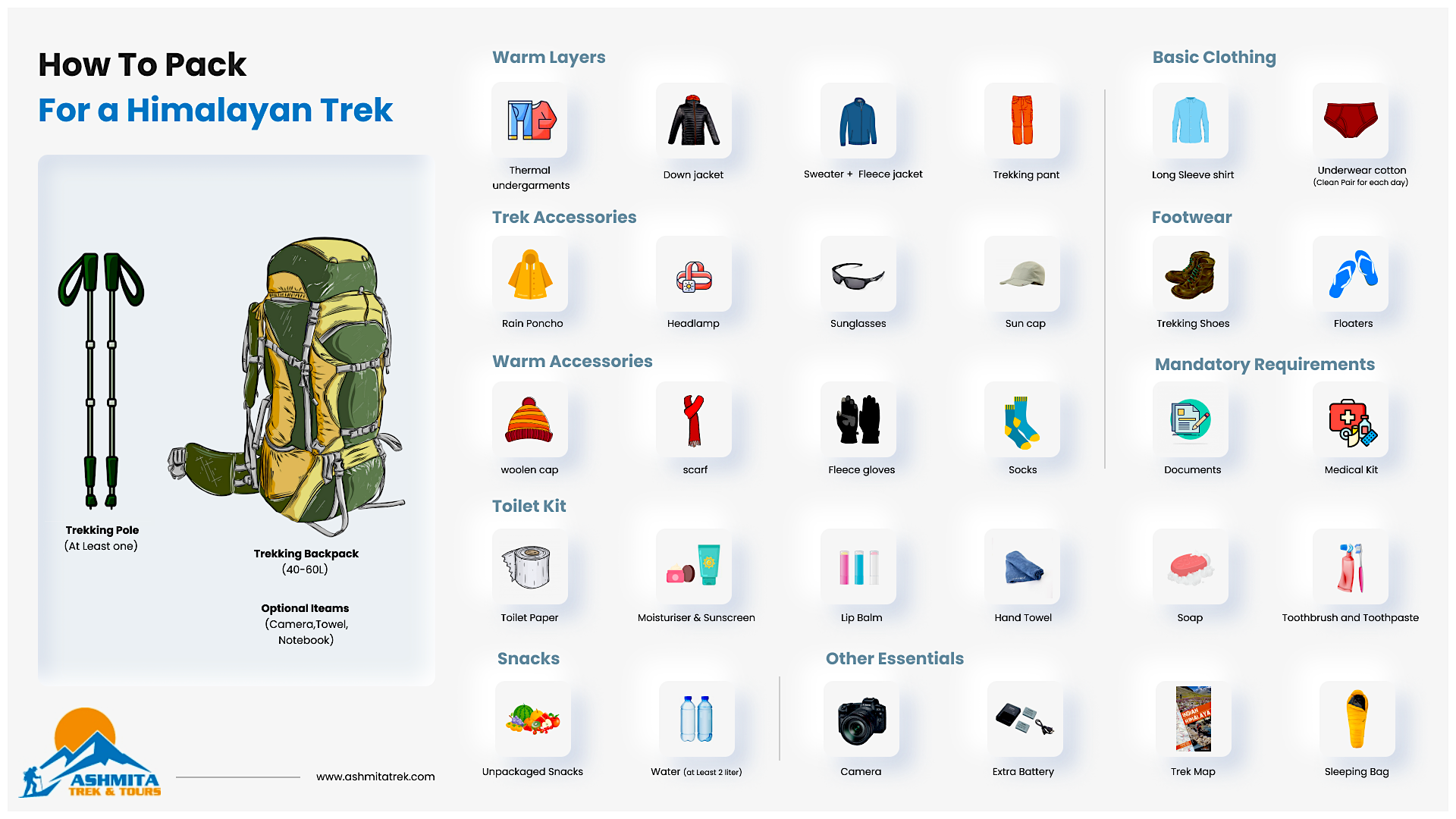
Sikkim Goechala trek packing list

  • Make sure you are carrying used trekking boots. If you are planning to buy new trek boots, get them early and break them.
  • Get a daypack with nice waist support.

Trek gear:

  • Duffelbag
  • Bagpack (with raincover)
  • Dry bags/zip-lock bags
  • Trekking boots
  • Camp sandals/flip-flops
  • Trekking poles
  • Sleeping bag with liner (four seasons)

Sun protection:

  • Sunscreen SPF 50+
  • Sunglasses with UV protection
  • Lip balm with SPF
  • Sunhat
  • Spray sunscreen to reapply

Clothes:

  • Comfortable undergarments
  • Moisture-wicking base layer (t-shirts and pants)
  • Thermal inner set
  • Fleece jacket
  • Down jacket
  • Waterproof/windproof jacket and pants
  • Beanie
  • Balaclava
  • Touch-screen proof gloves
  • Buff/neck gaiter
  • Thick wool socks
  • Thin liner socks
  • Warm sleeping socks

Miscellaneous:

  • Powerbank
  • Head torch + spare batteries
  • Smart phone and solar power bank
  • Camera (spare batteries recommended)
  • Universal adapter
  • Reusable water bottle (2 recommended)
  • Water purification tablets
  • Swiss knife/multi-tool
  • Spare boot laces
  • Duct tape
  • Lightweight mug
  • Travelers games
  • Book/journal and pen

Hygiene and toiletries:

  • Biodegradable soap and shampoo
  • Wet wipes (2-3 large packs)
  • Toilet paper (8-10 rolls)
  • Hand sanitizer
  • Toothbrush & toothpaste
  • Dry shampoo
  • Nail clippers, tweezers, pocket scissors, etc
  • Small mirror
  • Body lotion/moisturizer
  • Personal skincare
  • Comb

First-aid:

  • Paracetamol
  • Electrolytes
  • ORS
  • General medicines
  • Prescribed medicine (if any)
  • Bandage
  • Ointment
  • Band-aids
  • Insect repellent cream
  • Oximeter

Documents:

  • Passport/Aadhar Card (original + 3 photocopies)
  • 3 passport-sized photographs
  • Credit/Debit cards
  • Cash
  • Emergency contact card
  • Travel insurance documents (optional)
  • Necessary permits
Trip FAQs

Sikkim Goechala Trek - 14 Days FAQs

The Goechala trek is known for offering one of the closest views of Mt. Kanchenjunga, along with an adventurous gateway in the Himalayas in India.

The Sikkim Goechala trek starts and ends in Yuksom base camp

You can travel via air, rail, or road to reach Yuksom for the Goechala trek.

  • By air: Fly to Bagdogra Airport (IXB) in West Bengal and drive 6-7 hours to Yuksom.
  • By rail: Take a train to New Jalpaiguri (NJP) near Siliguri and drive for around 6 hours to Yuksom.
  • By road: Yuksom is connected to Siliguri, Gangtok, and Pelling. Private and shared jeeps are available.

Goechala as a difficult trek demand a sufficient level of fitness, therefore you should check You might not know what goals to set and how to reach them. so we Ashmita Trek and Tours designed three trek-specific workout guides line for you.

Suggested Preparation :

  • Cardio exercises include running, cycling, jogging, push-ups, and pull-ups for about 4-5 days a week for 3 months before your trip will begin.
  • You should also be involved in developing core strength. and muscle endurance through weight training.
  • Hiking in the hills in different weather conditions will be good preparation for this trip.
  • If you have access, kayaking will also be a very good way to develop the strength and endurance required for this trip.

Here’s a chart to help you get fit for the trek.

Easy

Backpack : 

(-10 C) (50 - 60 ltr) with multiple-compartments will surely help you to keep your personal belongings safe and organized a good quality haversack as to make all things to fit in one it must be comfortable while walking with it Sleeping bag. Day pack + rain cover 20 - 30 ltr (If hire a mule or porter)

Clothing & Accessories : 

The trek routes go from low to high altitudes. we suggest you T- shirt, pentagon with cap Extra socks, a water proof jacket, (rain coat requred in ranny Season ) Down Jacket/Gore tax Jacket, Light wind & water proof jacket , Inner sleeping sheet , Long sleeve T-shirts , Warm hat/ gloves,a good trekking shoe, make sure you choose the right footwear shoes have to be lightweight and durable, that offers complete and grip. a sun protection cream. Woolen cap and hand gloves. Warm jacket or a sweater and also a wind-cheater You experience strong cold winds especially in the months of September and October.

First Aid : 

Personal Medical Kit to heal minor injuries, cuts, or burns, carry your own small first aid kit with basic medicines and bandages. or Consult your doctor.

Flashlights : 

1 Nos Torch with extra battery or head light in important. 

Supplements : 

Water bottle , packet food like biscuits dry fruits (dates,cashew,almonds,resins etc) and sweets (Dry packet sweets-Cadbury-peanut candy) are to be carried as supplements during the treks.

Water bottle : / Hydration pack 2 bottles of one litre each People who use hydration pack

Trekking shoes :

We requred The proper foot wear depends on the trek. Shorter treks in low altitude can be done in comfortable running shoes up to 2000miters and while longer, more demanding treks in high altitude require sturdy trekking/hiking boots.

Here’s a guide to help you pack for the trek – 

Easy

The Goechala trek difficulty is considered moderate to challenging. Even though the trek is under 10 days, you hike 6 to 7 hours a day on rugged terrain and ascend above 4,900 meters from sea level. The cold climate, steep ascents and descents, and remote location make the Goechala trek a challenging experience.

Ghoechala Pass or Goecha la is high mountain pass in Sikkim ,India situated at an is 4,940 meters 16,207 feet above sea level.

Yes, Prior trekking experience is strongly recommended to do the Sikkim Goecha La trek. As this is classified as a Moderate - difficult, high-altitude trek reaching elevations of up to 4,940 meters (16,207 feet), it presents significant physical challenges.

While the trek is not strictly forbidden for beginners, it is not suitable for first-timers without rigorous training. High levels of physical fitness are essential to ensure both your safety and an enjoyable experience.

Spring (March to May) and autumn (late September to November) are the best times to do the Goechala trek. The weather and climate are favourable in these two seasons, and the mountain views are also great.

The Goechala Trek is a camping trek, not a lodge-to-lodge trek, as it lies within the Khangchendzonga National Park. Accommodation along the route is provided at designated campsites such as Sachen, Tshokha, Dzongri, Thansing, and Lamuney.

Yes, beginners can attempt the Goechala trek with proper preparation and support. You can do this trek without previous trek experience, but good physical fitness is required.

For the Sikkim Goechala trek, you will need a Khangchendzonga National Park (KNP) entry permit, Special Trekking Permit, and Sikkim Inner Line Permit (ILP). Additionally, foreigners are required to travel with a registered trekking agency, such as ours, as solo trekking is not permitted in this area.

Yes, foreigners can do the Sikkim Goechala trek. We organize the Goechala trek for foreigners every year.

Depending on the altitude and time of day, the weather during the Goechala trek can significantly vary. Nights and mornings are colder than the daytime. Likewise, the temperature drops with the increase in altitude.

Yes, April is one of the best times to do the Sikkim Goechala trek. It is the season of flowers, so the trekking route is blooming with vibrant colors of rhododendrons and many other wild flowers. Likewise, the weather, climate, and views are favorable in April.

The Sikkim Goechala trek is possible in the winter season, but extra preparation is required. It is the coldest time of the year, and the region also receives snowfall. You need warm clothes and a few winter trekking items too.

No, the Goechala trek is not recommended during the monsoon season. The trekking route is slippery, and the landslide risks are high. Likewise, the visibility is poor, and the frequent rainfall makes trekking challenging.

Trekking in the Himalayas comes with uncertainty, such as poor weather, altitude sickness, etc. If you are well-prepared and supported by a reliable trekking company, you can do the Goechala trek without any safety concerns. 

AMS or Acute Mountain Sickness is common during high altitude trips like the Goechala trek. It doesn't mean that everyone suffers from it. If you monitor your health and follow preventive measures, handling AMS is not a big deal.

  • Gradual acclimatization
  • Keep yourself hydrated and eat well
  • Maintain your pace and avoid overexertion
  • Recognize early symptoms of altitude sickness: headache, nausea, dizziness, insomnia, breathlessness, etc
  • Descent if necessary
  • Do not drink alcohol or smoke

The Goechala trek is a camping trip. You will camp in Sachen, Tshoka, Dzongri, Thangshing, Lamuney, and Kokchurang.

The distance from Yuksom village to Goechala view point is around 46 km.

The Goechala Trek is not technically challenging, but it is physically demanding. The trail includes steep ascents and descents, rocky and uneven terrain, high altitude, river crossings, and occasional snow sections. While good fitness is required, no technical climbing or mountaineering skills are needed.

The nearest airport to the Goechala trek starting point, Bagdogra Airport (IXB) in West Bengal, is about 180 km from Yuksom. You can hire a taxi or a shared jeep from the airport to Yuksom. It will take around 6 to 7 hours to drive.

There are no shops or bottled water available on the Goechala Trek. Trekkers should carry a reusable water bottle along with a water filter or purification system. Natural mountain water sources are available along the trail and are safe to use after proper filtration. Boiled drinking water is also provided every morning and evening at the campsites to ensure safe and eco-friendly hydration.

Yes, the Goechala trek is considered harder than the Kerdarkantha and Sandakphu. The Goechala trek is higher in altitude, longer trek duration and distance, and tougher in terrain.

Our Goechala trek itinerary includes both the Goechala viewpoint and Dzongri Top. If you are on a short holiday, you can end your trek in Dzongri.

Yes, You can book the Sikkim Goechala trek through our website or contact us. Choose your intended departure date and book the trek directly through our secure website. 

Yes, you can do a private Goechala trek any time of the year. You will have your guide, porter, and group and can enjoy the freedom to set your own pace. This arrangement works perfectly for couples, friend's or families. Let us know if you want to book a private trek!

Yes, solo trekkers can join a group for the Goechala trek. We have many fixed departures available in the peak trekking seasons for the Goechala trek.
Mobile and internet connectivity is available in Yuksom. During the trek, limited Airtel network may be available intermittently at Sachen and Tshokha campsites. Beyond this, connectivity is generally unavailable.

Yuksom is the last point with electricity on the Goechala Trek. There is no electricity along the trekking trail or at campsites, so ensure all phones, cameras, and power banks are fully charged before leaving Yuksom.

There are no ATMs in Yuksom. ATMs are available in Jorethang, Geyzing, Legship, Pelling, Siliguri, and Bagdogra Airport. Carry sufficient cash for the trek. However, UPI payments work well in Yuksom.

Phone and device charging is only available at Yuksom, the trek’s base camp. There are no charging facilities at the campsites along the trail, so trekkers should carry sufficient power banks to last the entire trek.